One of the last steps in the PCB (Printed Circuit Boards) manufacturing process, which we have described to you on this page, is the application of surface finishes, the main objective of which is to ensure the best soldering of components during assembly.
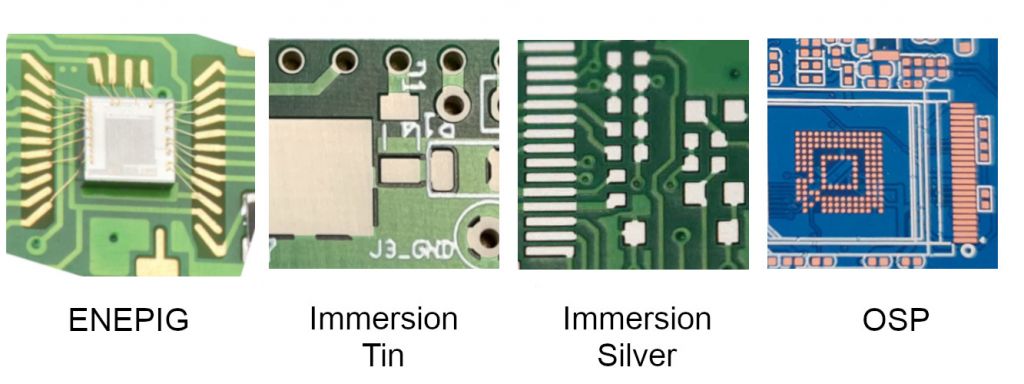
This article is the second in a “special” in which we wanted to delve into the characteristics of different types of surface finish to support you in the design phase.To reread the first part of this analysis, simply follow this link. The four finishes with which we will conclude the diesamine are as follows:
- Electroless Nickel Electroless Palladium Immersion Gold (ENEPIG)
- Chemical Tin (Immersion Tin)
- Chemical Silver (Immersion Silver)
- Organic Solderability Preservative (OSP)
Please note that the choice of the best surface finish should be made on the basis of several aspects, always referring to the IPC Guidelines for the type of components that will be mounted on the board and to the type of process in use by the EMS (e.g., reflow and soldering modes).
In addition, surface finishes have a bearing on the way the material is stored and shelf life, which determines the time within which PCBs should be processed after the production process is completed.
The main features of the four technologies above follow:
Electroless Nickel Electroless Palladium Immersion Gold (ENEPIG)
ENEPIG is one of the latest technologies in surface finishing having been on the market since the very early 2000s. The main feature that makes it different from other finishes is its “bondability” (wire-bonding) guaranteed by the three-layer metal coating composed of nickel, palladium and gold. It also surpasses all other finishes in post-assembly corrosion resistance. It is often used in high-frequency applications where space is very limited, offering excellent performance also in terms of reliability, packaging requirements, and compliance with the RoHS standard.
The use of a rare and expensive material such as palladium, together with the need for a dedicated line, causes its very high cost.
Immersion Tin (Chemical Tin)
As per IPC definition, Chemical Tin is a metal finish deposited by chemical reaction directly on the PCB base material i.e. copper, protecting it from oxidation to the benefit of shelf life.
Key advantages include flatness, lack of lead, the possibility of board reworking, and ideal compatibility with Press Fit technologies for connector insertion.
The disadvantages of this technology are the difficulty of measuring its thickness accurately, the ease with which damage from poor handling can occur, and the hazardous nature of using Thiourea reagent. In addition, exposed Tin can corrode during final assembly. It is preferable to avoid this finish in the case of assemblies requiring multiple reflows.
Organic Solderability Preservative (OSP)
OSP is a finish that preserves the surface of copper from oxidation by applying a very thin protective layer, using an organic-based aqueous chemical compound, over the exposed Copper by a conveyorization process.
Among the pros of this finish we certainly find its greater eco-friendliness than lead-free finishes, which are more toxic and energy-intensive. In addition to the non-use of Lead, other advantages include the flatness, reworkability and simplicity of the process that keep its cost all in all low.
The main weaknesses are the short shelf life and the delicacy with which the boards must be handled. In addition, it is not easy to measure its thickness and is not ideal for processes involving PTH (Plated Through Holes). Finally, it should be remembered that Copper is exposed during final assembly.
Immersion Silver (Chemical Silver)
Chemical silver is a nonelectrolytic finish that deposits a thin layer of silver (between 0.13 and 0.46 µm) by immersing the PCB in a pool of Silver ions.
The strengths of this finish are good eco-friendliness compared with HASL LF and ENIG. The workability window is smile to that of HASL LF, compared with which it is more planar.
The disadvantages of this finish are, mainly, the need to solder as soon as the PCBs are removed from their protective packages and the caution with which they must be handled as they tend to oxidize easily. Finally, Immersion Silver is less durable than ENIG because of the lack of nickel intermetallic.
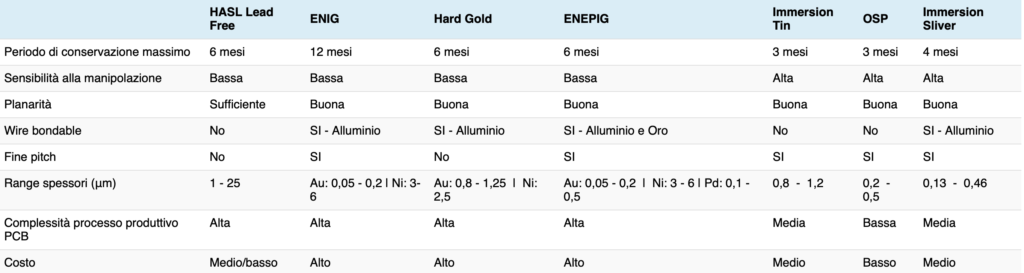
We conclude this in-depth study with a summary diagram that makes it quicker and easier to consult the main characteristics of surface finishes:
For more information on surface finishes, please feel free to contact us via our form or direct references from our technical staff.